Showing posts with label coral. Show all posts

Saturday, 23 August 2014

Pompeii No.25: Adding Coral For Good Health


This week I'm adding coral branches to the mural!

Coral, once believed to be a sea plant, is actually the cumulative skeletal remains of living animals called polyps. For thousands of years, many cultures have viewed coral as a decorative gem as well as protection against disease.

In Ancient Rome, coral was believed to protect against childhood disease and to avert evil, and it's still seen as good luck in Mediterranean countries and places like India, Tibet and Japan.

Piero della Francesca  |  Rizzoli
Piero della Francesca portrayed the Christ Child with this necklace of coral, and hanging from it, a coral branch. The painting dates to circa 1475.

Mantegna: I Maestro del Colore  |  Fratelli Fabbri
Mantegna (one of my favorite artists) hung a huge branch of coral above the Madonna and Child in this painting, which dates about 20 years later than della Francesca's. Below is a detail.

Mantegna: I Maestro del Colore  |  Fratelli Fabbri
I'll be using della Francesca's and Mantegna's coral as models, but . . .

PubHist.com

. . .  I wanted to include later images of coral to illustrate how the gem was revered through the ages. The painting above, by Jan Claesz, dates to circa 1609, and shows a girl who has both a coral necklace and a rattle that incorporates pink or white coral at its tip.


Christie's auction
Such rattles often doubled as whistles. Above are English rattles dating to the early 20th century, a full 400 years after the rattle in Jan Claesz's painting. My blogging friend Rosemary, of Where Five Valleys Meet, says of these rattles, "The coral section of the English Victorian rattles was there to sooth the baby's gums when teething. Coral did not chip or splinter, and is cool to the touch. The coral also provided some comfort and reassurance to parents because of its mystical protection, as you have mentioned."

Incidentally, these four rattles recently sold at auction for approximately $2200, total, which I imagine would make a collector of such items very happy.

I'll be hanging the coral branches
over the mural's three smaller garlands.

click to enlarge
Above are the finished corals. As you can see, I scoured the seas for three branches that were similar in shape as well as size.

Friday, 15 June 2012

Florida's Rarest, Most Colorful Coral Reef


St. Petersburg, Florida's premier crafts gallery, Florida Craftsman, is currently hosting a fiber coral reef, a coral reef that is completely crocheted!


With the assistance of local marine scientists — there are more than 1,500 in St. Petersburg — 267 artists from England, Norway, Canada, Mexico, Texas, Pennsylvania, Ohio and all around Florida have contributed to a crocheted coral reef.


The project is in conjunction with a similar coral reef exhibit that's been traveling around the country since 2007.


I noticed that crocheting especially lends itself to brain coral patterns.


Quoting from the gallery legend, "Corals are made up of colonies of tiny animals known as coral polyps. these coral polyps can create a variety of structures, from a solitary disc the size of a silver dollar, to an intricate and elaborate tree-like structure, to a massive boulder the size of several Volkswagens! The collective growth of these structures over thousands of years make up what is known as a coral reef."


"Coral reefs are known as the 'tropical rain forests of the sea' because of their complex, delicate and highly diverse ecosystems. The sophisticated structure of a coral reef provides homes to thousands, if not millions of organisms that all depend upon one another to sustain their lives."


The gallery legends also stress the importance of coral reefs to mankind, and warn that we are in danger of losing 90% of our coral reefs within the next 50 years!


Part of the exhibit was even dedicated to illustrating the results of oil spills.


When the coral reef is stressed — through heightened water temperatures for example — the algae that provides the coral's pigment is expelled and the coral is "bleached." Though not dead, in order to survive the reef will need conditions to come back to normal and the (zooxanthellae) algae to return.


There is a quality of humor and kitsch in the exhibit that is more than counterbalanced by its scope and size. Regardless, it's an awesome project, and the best part of visiting the crocheted coral reef is to see the complete delight of all the viewers, from adults to toddlers.
.

Saturday, 18 September 2010

Venetian High Rise in Florida


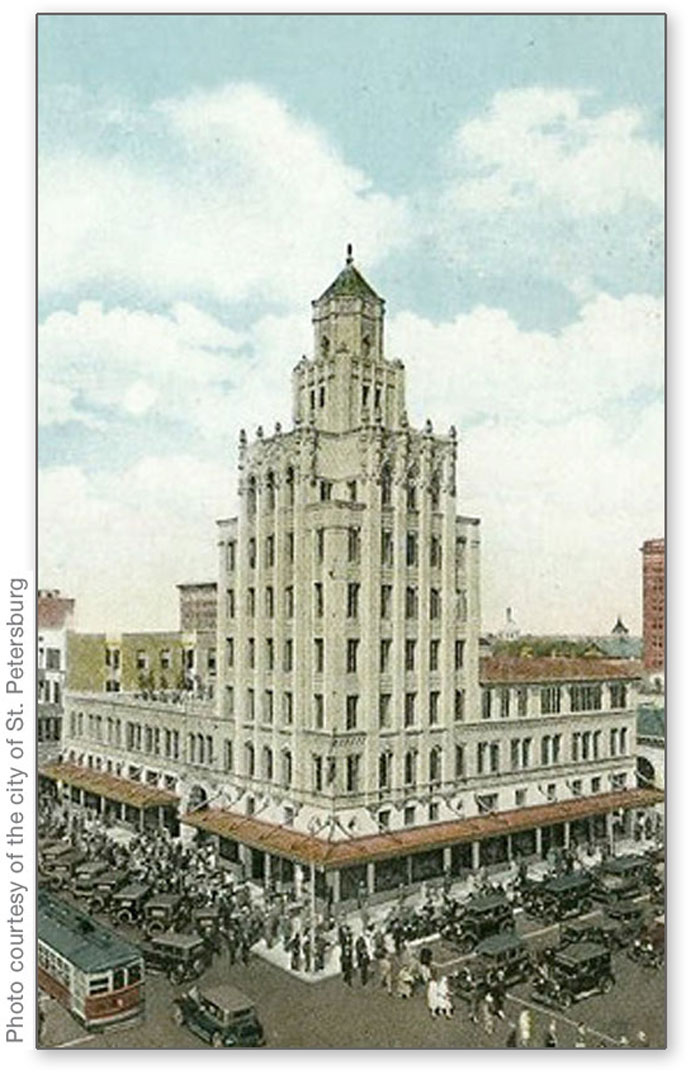
Architect Design™'s gorgeous September 1 posting on the OAS building, and his equally exciting September 6 posting on the Pan American building - both in Washington, D.C - inspired me to share the Snell Arcade with you. It was built 18 years after the other two (1928) but has some of the same decorative feel. And yet it is different; I would describe the Snell Arcade as Mediterranean Deco (my own label).

The Snell Arcade is at the main intersection of downtown St. Petersburg, Florida. Officially called the Rutland Building, it is familiar to one and all by the name of Snell. C. Perry Snell was a major developer of St. Petersburg, and it's clear that his own vision was to create on a grand European scale. He favored wide boulevards lined with statuary, and beautiful Mediterranean architecture.


Maybe this should be called Venetian Deco. What do you think?  I've always had a secret desire to completely dismantle the Snell Arcade and reassemble it into my own two-story house. Scale might be a problem, but I'd make it work.


Look at the narrow strips of blue tile between the courses of stone block! Would anyone have the panache to do that today?


The base of the Snell Arcade is made from coral, a practice that has been banned more recently, of course. In my next posting, I'll show you a little treasure inside the Snell Arcade.