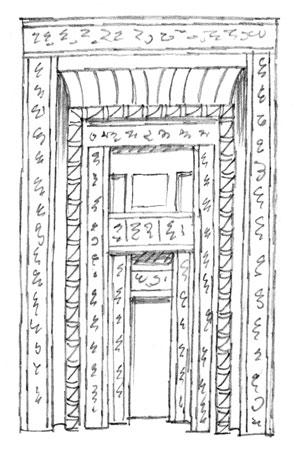
Several years ago, the Florida International Museum (sadly no longer in operation) hosted a splendid exhibition of Egyptian antiquity. I took a sketchbook along and made notations of those articles that were of most interest to me.
I was particularly impressed by a temple door that was actually levels of concentric door frames. Standing in front of it, I thought to myself, "I'd love to build a grand door like that someday."
Shortly thereafter I designed a temple door in the house of friends. They had a carpenter build it to my specs and he did a wonderful job. Because the house was not my friends' primary residence, the door remained unadorned for a long time, as shown above — not unlike an uncarved totem!
Recently, the house became their primary residence, and it was time to finally finish that door!
 |
| click to enlarge |
Here's the door as it appears today.
I started at the base (and was happy that no one was there to photograph me as I sprawled on the floor). I put the hippopotamus at the base because he's the king of the Nile. Above him are stylized flora, and above that our solar sun. This segment of the door frame represents the physical world.
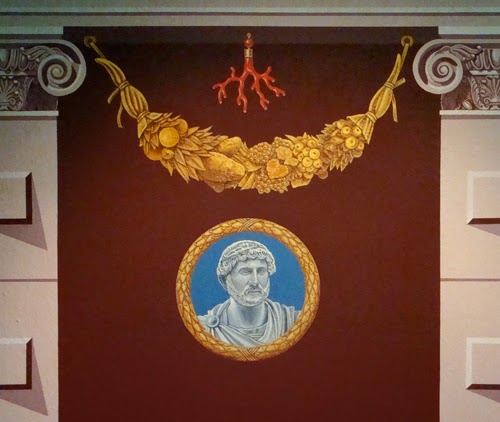
The next segment depicts the Roman-Egyptian god, Antinous Osiris. Antinous was the partner of the Roman Emperor Hadrian, and he drowned in the Nile. Hadrian then proclaimed him a god and had many temples built in his honor. So this segment of the door frame represents ascension as the Ancient World would have believed it. Above Antinous Osiris I've positioned a hieroglyphic of my own design. The two center triangles are a variant of the Star of David, one interpretation of which is energy simultaneously ascending and descending.
The next segment depicts the individual monograms of the two owners. Sphinxes support a cartouche that is framed by the snake that devours its own tail, the symbol of eternity.
I did a study of hieroglyphics, and these are bona fide inscriptions of a spiritual nature, relevant to each owner. Hieroglyphics are so interesting. Because vowels were not represented, similar-sounding words like "bat" and "bait" would have the very same iconography, followed by an icon that actually illustrated the item. There must have been a better way to communicate, and there was!
I was tickled that the paintings I did of the owners, two delightful gentlemen who have been partners for more than 50 years, are close enough likenesses that several of their friends wondered how I transferred photographs onto the wood!
The cartouches next to each portrait reveal the owners' names spelled phonetically in hieroglyphics. In Ancient Egypt, such cartouches would only be used for royalty or high officials.
The very stylized capitals are loosely based on the capitals of a temple in Thebes, a temple that was referred to as a "memnonium."
 |
| click to enlarge |
The winged sun, which in the Old Kingdom would have looked like the black and white image, is actually a cross-cultural icon that has been used across the ages in many countries, and by many religions. It varies in meaning, representing royalty, sun gods, or the One God. I gave it a more universal interpretation, to represent Oneness.
.