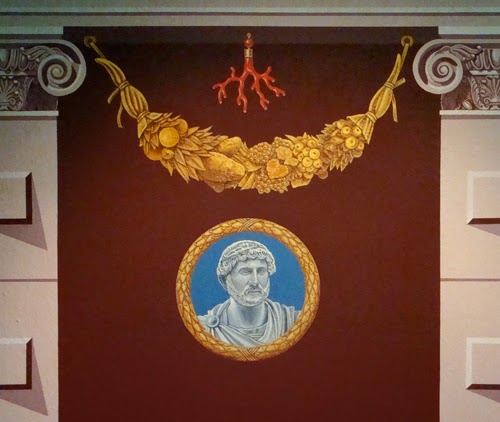
In my last posting, I dedicated a bust on my dining room's transom to Emperor Trajan. Trajan died without an heir, but is reputed to have named his cousin, Hadrian (76 A.D.-138 A.D.), on his deathbed.
Hadrian is always depicted with large and tightly permed curls around his forehead, and he was the first of the Roman emperors to sport a beard. He spent much time raising the standard and readiness of the army, and had a preference for wearing military uniforms.
 |
| Hadrian and Antinous | www.britishmuseum.org |
Hadrian had from an early age immersed himself in Greek culture (hence his beard), so much so that as a young man he was nicknamed Graeculus, or "Greekling." Even the shortest biography would be incomplete were it not mentioned that he loved all things Greek, including a Greek youth named Antinous. When Antinous drowned (probably between the ages of 18 and 20), the emperor literally idolized him, erecting temples in Antinous' name. Throughout his reign, Hadrian continued to pay much attention to the welfare of Athens, which he promoted as a cultural center of the Roman Empire.
 |
| The Pantheon | commons.wikipedia.org | trekearth.com |
Because Hadrian reigned during a stable period, he had the luxury of patronizing the arts and of beautifying the city of Rome. The computer-generated, marbled sets of Rome that we see in movies like
Gladiator are probably approximations of Hadrian's projects, which were both new monuments and renovated ones. He is especially remembered for the construction of the Pantheon, which was, and remains, an architectural and engineering marvel. Its dome is even larger than the Vatican's.
 |
| Hadrian's Wall | photograph by Oliver Benn/Getty Images |
Despite his affinity for military maneuvers, Hadrian averted war through diplomacy, and abandoned inroads Trajan had made into Mesopotamia and Armenia when he concluded them to be militarily indefensible. To ensure peace, he also strengthened Rome's borders, most notably erecting Hadrian's Wall across Rome's northern border of Britannia.
Hadrian was considered wise and just; he revised the legal code, and though he did not abolish slavery, he diminished it and its excesses.
My design for the portraits of the remaining three emperors somewhat resembles a plaque by Josiah Wedgwood, or perhaps a roundel by Andrea della Robbia.
I chose a golden frame to complement the golden garland that hangs above. I think it's quite appropriate that this image of Hadrian is positioned above the Muse of Architecture. (I'll show the whole wall a little later.)
I hope you'll join me next week when I reveal a portrait
of the fourth of the Five Good Emperors.
.