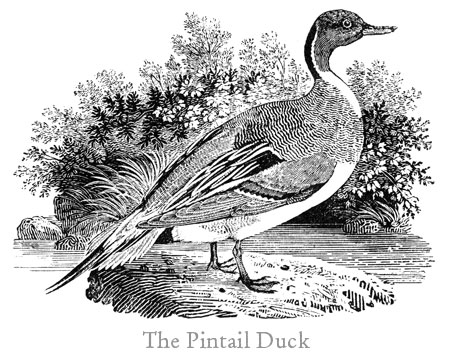
Thomas Bewick (1753-1828) remains England's foremost wood engraver. By all accounts, he had an idyllic childhood, romping about outdoors in Northumberland instead of attending to his lessons. His aptitude for drawing was noticed early (how could it not — he drew all over the steps to church), and he was apprenticed at 14 to a silver engraver. The engraver let Bewick handle orders from printers, who required woodcut images.
In those days, images and frames for advertising tended to be rather crude, and they were usually cut from the face of a board. Bewick instead used the end grain of the wood. The end grain was a much harder surface, which allowed for fine detail and many more printing impressions. Some of Bewick's blocks have been printed as many as 900,000 times!
When Bewick's apprenticeship was finished, he sought work in London, but finding it too crowded and unfriendly, he moved back to Northumberland, where through his great talent, he had a very successful career.
He printed a number of books, including the General History of Quadrupeds, the History of British Birds, the Cries of London (images of street criers), Aesop's Fables, and the Poetry of Robert Burns.
His images of animals are not only correct, but portraits of individual personalities. Looking at the scope of Bewick's work, it's clear that he observed wildlife with a very keen eye. His settings and backdrops are equally elegant. Notice how grass overlaps the boundary of the sod above, and how Bewick brings life to the rat by having its tail overlap the sod as well.
Bewick's most popular work was the History of British Birds. Scores of birds were depicted with accuracy and in his inimitable style. The bark on the tree above, and its shadowing, are typical of Bewick's illustrations.
Bewick's fame spread (John James Audubon was just one who called on him), and as demand for his work grew work, Bewick taught and employed other wood engravers to assist him.
Illustrations from Aesop's Fables
I want to point your attention to this ad for the druggist J. Garnett. It was probably a lesser job for Bewick, but look at the beauty and care with which it's done. Smaller, delicate marks achieve a sense of distance, and the illusion of a reflection on the water is very convincing.
I'll end with this handsome frontispiece by Thomas Bewick. It has all the earmarks of his genius — stylized and densely detailed foliage; an elegant allusion to simpler, genteel times; a beautiful animal captured in a natural moment; and perfect shadowing executed in a completely black and white line format.
Thomas Bewick's work was so popular that he revitalized the art form of wood engraving for six decades beyond his death. A host of engravers closely imitated him, including his talented employees, and therefore it's not always easy to know authorship. I've carefully selected these images from a book of Bewick's work, believing them by sheer virtuosity to be the "real deal."
P. S. This posting's header is a detail of this beautiful woodcut. Be sure to read my blogging friend Rosemary's comment below, which gives some interesting backgound on this image.
.
.