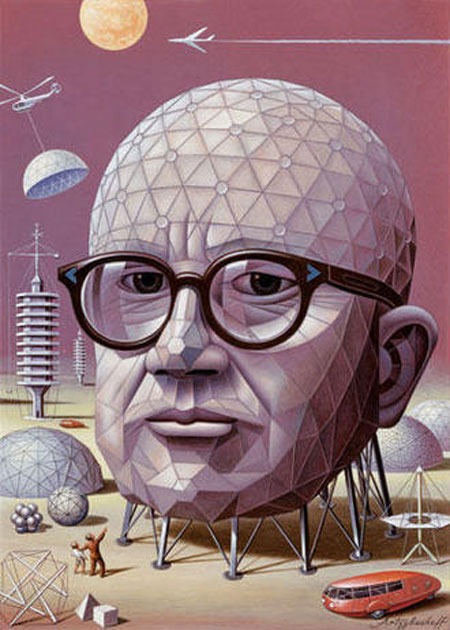
As I was growing up, the arrival of
Time magazine was always one of my weekly high points. Because news reporting was not as instantaneous then as it is today,
Time would feature an in-depth news trend, and that would almost always be reflected in a beautifully executed cover design. As a teenager, I started collecting
Time covers, in large part because of the striking portraits of
Boris Artzybasheff.
Artzybasheff was famous for illustrating anthropomorphic machines, and conversely, he would sometimes paint portraits of people as the object for which they were known. Artzybasheff's portrait of Buckminster Fuller as a geodesic dome is probably the most famous example.
Today I thought you might enjoy a collection of anthropomorphic portraits by a variety of artists. I call this posting, "You Are What You Are." Most of these will enlarge if you click on them.
Dave Stevenson depicted Frank Lloyd Wright as an architectural blueprint, for a Simpson Paper Company promotional brochure. Stevenson actually had a blueprint made of a black and white ink drawing.
Illustrator John Craig created this collage of Henry Ford for the same 1986 Simpson Paper Company brochure.
My favorite in the Simpson Paper Company series is this portrait of
Charles Francis Richter, creator of the Richter Magnitude Scale. It's also by Dave Stevenson. Be sure to click on this and see it enlarged!
This architectural portrait of Le Corbusier is by Louis Hellman, a very witty architectural cartoonist. You can see his mausoleum to a baroness
here.
This astonishing self-portrait of Scott Marr is in the form of the Australian natural elements that Scott draws, in part by burning into wood. It's an art form known as "pyrography." You can see more of Scott Marr's exceptional work by visiting my blogging friend Theresa Cheek's great posting about him,
here.
This is a self-portrait patchwork quilt by quilter Mary Elmusa. It measures 30" x 30" and is made of dyed cotton fabric, stitched with metallic thread. This image and other great quilts can be found at kansasartquilters.org.
Milton Glaser of Push Pin Studios made this delightful portrait of Alexander Hamilton as a collage of banknotes and financial documents. It dates to the mid 1960s.
Charles Tsevis created this portrait of Steve Jobs using Apple products. It dates to 2008 and was found at iTech News Net,
Latest Gadget News and Reviews.
This portrait doesn't fit into my theme exactly, but no posting of anthropomorphic portraits would be complete without an example by Giuseppe Arcimboldo. Were it to fit properly into my theme, this would be a portrait of a gardener. Actually it's believed to be a portrait of Arcimboldo's patron, Holy Roman Emperor Rudolf II (1552-1612). I personally would have refrained from depicting my patron as a stack of vegetables, but the portrait was presented to Rudolf II as Vertumnus, God of the Seasons. Rudolf II loved it, and commissioned a similar painting for each season.
.