Showing posts with label tobacco ephemera. Show all posts

Thursday, 13 February 2014

19th Century Cigar Labels

As my regular readers know, I collect antique advertising, mostly in the form of lithographed trade cards, which you can read about in my sidebar, or here. I don't go out of my way to collect cigar labels because I don't want to stray too far from my field of collecting. But every so often I come across early cigar labels, those that were lithographed on plain rag paper like the rest of the collection. I'd like to share a few from my collection, and I estimate that these are all approximately 135 year old.
This label and the following one both emphasize the important commercial aspect of the cigar industry in the 19th century. Cigars were of course a major Cuban export, after sugar. In the United States, cigars held a special function for all the industrial shipping that moved south by river. When those vessels were emptied, they were often laden with cigars for the trip back north.

Mercury is the Roman god of commerce, so he is honored here with his own "El Comercio" brand. (I'll have to add that Greek key to my sidebar page on Greek keys!) This Mercury is a little portly, and his helmet appears to be a golden Homburg.

Lithography was a new color printing process in the 1800s, and the influx of rich colored images caused many people to save labels of all sorts, sometimes for scrapbooking and sometimes to adorn their walls. This colorful image was carefully cut out from a bigger label. (We should have known that the gods of tobacco rode in on a dragon.)

I've featured this American beauty before, but it's such a rich example of early lithography that I'll show it again. It's only about two inches high.

I've scanned this Cuban label which was actually lithographed in Germany. Unfortunately, scans absolutely deaden items that are gilded, so I also took a digital image of this spectacular piece of paper, below.


I'm adding the image below, which may or may not be a cigar label. Nonetheless, it's Victorian graphic design at its best, and a message good for today and tomorrow!


Have a Great Day!

.

Friday, 4 October 2013

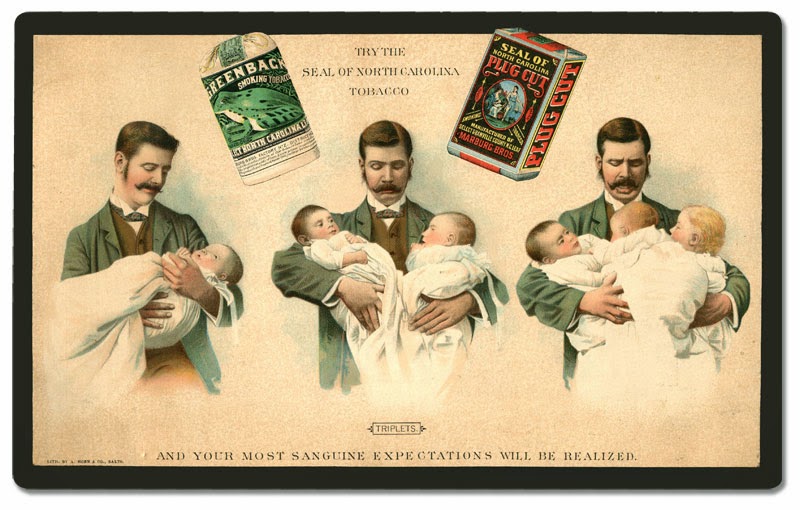
Amusing Advertising for Greenback Tobacco

As I have mentioned before, it's ironic that I've never smoked, for my ephemera collection is heavy with good tobacco advertising of the 19th century.

click to enlarge
In my side bar page on antique trade cards, I note that 19th century advertising often had imagery that had little or nothing to do with the product being sold. The charming card above, which measures 12¼" x 7½", is a prime example.

For my own collecting purposes — which are very much rooted in an interest of graphic history — I like that the card beautifully illustrates the tobacco's packaging.

While the plug cut is wrapped in paper, you can see that the Greenback tobacco is a cloth bag with a draw string, surrounded by a paper label and seal. The paper around the Greenback would have been discarded immediately, so I would surmise that if any labels are still in existence, they'd be mint and unused.

The quality of the artwork and lithography is very fine. While Marburg Brothers was obviously in North Carolina, the advertising was done by Hoen & Co. of Baltimore, Maryland. If you click on the link, you'll see that the lithography was probably the most advanced of its time.

click to enlarge
.

Saturday, 21 July 2012

Garbáty Cigarette Balloon & Blimp Cards

Netzballon

Regular readers of this blog know that I collect antique ephemera and trade cards. You can read more about that on my side bar or right here. While the trade card fad ebbed at the turn of the last century, cigarette cards continued to be popular a little longer.


This posting features balloon and blimp cigarette cards that were issued in the early 1930s by the Garbáty Cigarette Company of Berlin. The cards were lovingliy pasted into the above album, but for the sake of your viewing, I've regrouped them below.

click to enlarge
Left to right and top to bottom: Höhenforschungsballon Bartsch v. Sigsfeld; Kugelfesseballon, 1878; Drachenfesselballon; Stromlinienförmiger Fesselballon, 1918; Andrees Polarflug; Andrees Ballon nach der Auffindung

click to enlarge
Left to right and top to bottom: Deautscher Freiballon Wettbewerb; Fesselballon; Aufstieg des Piccardschen Höhenforschungsballons; Piccards Höhenforschungsballon landet in den Alpen; Parseval I (erster Parseval), 1906; Parseval (späterer)

click to enlarge
Left to right and top to bottom: Siemen-Schuckert, 1911; Erstes Militär-Luftschiff MI, 1908; Veeh-Luftschiff; Ruthenberg-Luftschiff; Clement Bayard, 1908; Astra "Adjutant Reau"

click to enlarge
Left to right and top to bottom: Ville de Paris, 1908; "Pilgrim" der Good-Year Gesellschaft, 1925; La Liberté, 1909; N-I Norge, 1923; Zeppelin Z I, 1900; Afrika-Luftschiff

click to enlarge
Left to right and top to bottom: "Deutschland" (L Z &), 1910; d L Z 127 "Graf Zeppelin";  L Z 120 "Bodensee", 1919; L Z 121 "Nordstern", 1919/1920;  L Z 126 (R Z III "Los Angeles", 1924; Marine-Luftschiff "L 3"

click to enlarge
Left to right and top to bottom: Marine-Luftschiff "L71", 1918; Z 4 (Zeppelin des Unglücks bei Echterdingen); 1. Schütte-Lanz, 1915; Schütte-Lanz (späterer); Gerippe eines Zeppelin-Luftschiffes; Motorgondel eines Zeppelin-Lunftschiffes

click to enlarge
Left to right: Führergondel eins Zeppelin-Luftschiffes; Navigationsraum eines Zeppelin-Luftschiffes; Schlafraum und Wohnkabine ("Graf Zeppelin")
.

Wednesday, 20 June 2012

Victorian Metamorphic Cards


Metamorphic cards were popular in the later part of the 19th century, but are rarer finds for today's advertising collector. They were folded to show a before view . . .

. . . and then opened to reveal a surprise ending. 

Buckingham's Dye must have been a popular brand because it's the most common of the Victorian metamorphic cards. Before, and . . .

. . . after!

And don't we suppose that it was very, very dark? The back of the Buckingham card promotes another hair product, Vegetable Sicilian Hair Renewer. Its makes for some interesting reading:

Does it do anything for sore feet or ulcers?
.

Friday, 17 June 2011

From Tobacco Cards to Baseball Cards


If you've had an opportunity to visit my page on trade cards and the evolution of corporate identity (in the right-hand sidebar), you know that Victorians of all ages enjoyed receiving little premium cards with virtually everything they purchased.


The cards of tobacco companies were especially popular because they were often distributed in sets. Above is one of my cards from the 1870s, of Edwin Booth, brother of John Wilkes Booth, and one of the greatest actors of the 19th century. It was distributed by Between the Acts Cigarettes, and would have been included in a set of famous actors.
From my collections, here are two views of a Between the Acts tin from the 1920s. It still has its tissue and all the cigarettes!

Metropolitan Museum of Art

The ancestor of the bubblegum card was the tobacco card. Customers going into a tobacco shop might have seen a poster like the one above. It displays a complete set of racing colors, each card of which was in an individual pack. Of course one would have had to smoke a lot of cigarettes to get a complete set.

Click to enlarge

I was fortunate enough to find a cigarette poster by the same tobacco company. It features all the rulers of the world, and dates to the 1880s. In the poster, all of the cards are actual size.


These handsome cards from the Jefferson R. Burdick collection, at the Metropolitan Museum of Art, were distributed by the American Tobacco Company in 1911. As tobacco card sets progressed, there became a greater emphasis on sports and athletic teams.


The rarest baseball card is this 1909 Piedmont Honus Wagner, which recently sold for $1.62 million. The card was in early distribution when Honus Wagner objected to being associated with the sale of tobacco, and demanded that all remaining cards be withdrawn.

Perhaps Honus Wagner, who was very popular, was a factor in the transition from tobacco cards to bubblegum cards. More likely it had to do with the gradual death of trade cards in general. In any event, the collecting of baseball cards shifted to a younger demographic, and the cards came to be issued by candy companies.


These striking cards, also from the Metropolitan Museum of Art, were distributed with Cracker Jack candy between 1914 and 1915.
.

Wednesday, 27 April 2011

Tobacco Ephemera 5


While silks are not technically ephemera, they were among the many premiums distributed by early 20th century tobacco companies. I don't actively collect tobacco silks, but they occasionally show up in trade card collections. This silk and the two that follow were distributed by Nebo and Zira cigarettes, early brands of the American Tobacco Company. They date to circa 1910. King Ferdinand was one of a set of 10 called Rulers of the Balkans and Italy.


Queen Ester and Queen Louisa were part of a set of 15 call Famous Queens.

click to enlarge

Tobacco silks came in a variety of sizes and were popular with collectors, who often sewed them into quilts. This quilt is from Fabrics.net, and similar tobacco quilts can be seen at that site, here. Also at Fabrics.net are smaller quilts, perhaps table covers or wall decorations, that were made from the colorful yellow ribbons that were used to tie up bundles of cigars.

My thanks to Fabrics.net.
.

Monday, 25 April 2011

Tobacco Ephemera 4


The image above must have been shockingly racey and sexy when it was printed in the 1880s. No lady would have smoked in public then — or bared so much shoulder (gasp!). At 6", this die cut is larger than most trade cards.
.

Saturday, 23 April 2011

Tobacco Ephemera 3

click to enlarge any of these three
Horseshoe Cross Bar was a cut plug tobacco. (It appears that in the 1800s, just as today, cut plug was associated with sports!)

Much of my antique advertising collection is in the form of trade cards, and if you haven't had a chance to view my page on trade cards (in the sidebar), you can access it here.

Horseshoe Cross Bar issued trade cards that looked like the image above, though this example and the two images below are actually from packaging. When the Victorians were pasting trade cards into their albums, they often also included packaging scraps. And aren't we glad they did!


I want to note here that these colors have not in any way been enhanced. The Victorians did not used the 4-color printing process that we use today. So in these lithographed pieces, if a brilliant orange-red was desired, a brilliant orange-red ink was used.
.

Thursday, 21 April 2011

Tobacco Ephemera 2


Ephemera, as I've mentioned before, is paper memorabilia that was never intended to be saved. This is a wonderful example of ephemera — it's a paper packet that held three cheroots. Someone long, long ago liked the design enough that they set it aside, and if not for them, we wouldn't be looking at this great example of Victorian graphic design.

click to enlarge

Just what is a "cheroot?" It's a small cigar that's clipped at both ends. Because the ends don't taper, the cheroot is easier and faster to roll and therefore less expensive than finer cigars.


I wish I could reach out and share this in person! This packaging is printed with a gold ink that is quite reflective now; it must have absolutely glistened in 1886.
.

Tuesday, 19 April 2011

Tobacco Ephemera 1


I thought that over the course of several postings, I'd share some tobacco ephemera from my advertising collection. This piece, which acts like a pocket, is made of very stiff paper, and it doesn't seem suited for holding loose tobacco or cigarettes.

click to enlarge
I think it was a neat little folder for holding cigarette rolling paper. Don't you love the leathery background? Perhaps it's meant to be alligator skin. Here's the back.

.